
An excerpt from Compassion in Practice: The Way of Jesus
What does a compassion-based activism that fights for justice while loving our opponents look like in practice?
Compassion-based activism is defined by the spirit or energy with which any actions are performed. To guide us in embodying such actions, what we really need is a compass aligned with the spirit of compassion. A compass helps us get our bearings when we are lost or disoriented.
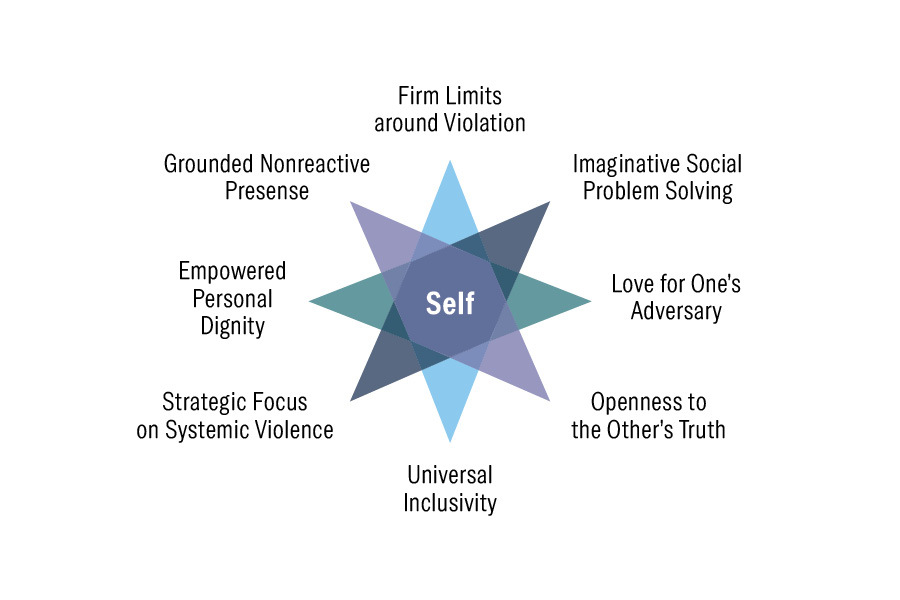
Eight coordinates circumscribe the compass of compassion-based activism, each one needing to be balanced by an opposing coordinate for the needle that would guide us to be truly spiritually aligned and pointing us in the direction of due north. Taken as a whole, this compass orients us toward what compassion-based activism might look like in any situation of violence or violation.

Jesus invites us to “turn the other cheek”—to stand up to violation with dignity, personal power, courage, and a commitment to survive, even flourish, in the face of that which would degrade us. As such, compassion-based activism is not passive before violation. Rather, it emboldens our personal power in the face of an abuser.
Compassion-based activism recognizes the humanity of the other—they too have known suffering; they too have terrors and are fighting for their lives; they too have capacities for love, generosity and good will.
Compassion-based activism embodies a universal inclusivity. It extends love to everyone. It embodies a radical inclusivity that treats everyone with dignity, compassion, and hope for restoration.
Compassion-based activism also places firm limits around violation. It invites a radical reconciliation with even the most hardened perpetrator, but it recognizes that reconciliation is not naïve or cavalier. Reconciliation has conditions.
Compassion-based activism is grounded in non-reactive presence. Its responses to violence embody an inner stability even in the midst of challenge, conflict, or attack.
Compassion-based activism recognizes that our adversaries are fighting for something that feels life-threatening to them. The compassion-based activist seeks to understand with genuine openness the truth that informs an adversary’s life posture.
Compassion-based activism involves rigorous and strategic social analysis. It educates itself about the systemic causes of violence in our world. And it seeks both to free those who are captive to these systems and to transform the systems themselves.
Compassion-based activism is free, creative, imaginative, and playfully innovative. It sees violence as a problem-solving opportunity to brainstorm possibilities that might defuse tensions, shift the power dynamics, and invite an alternative relationship between the parties.
These eight qualities are the coordinates on the compass of compassion-based activism. When we find ourselves in the midst of violence and violation, compassion-based activism leads us on a path to embody empowered personal dignity while extending compassionate love for our adversary, to align with a cosmic universal inclusivity while firmly establishing limits around violation, to be calmly grounded in a truthful non-reactive presence while curiously open to our opponent’s truth, and to focus strategically on systemic violence while creatively engaging in imaginative social problem-solving.

Learn more about the Compass of Compassion-based Activism and other practices in Compassion in Practice: The Way of Jesus, available from The Upper Room here. Save 20% now with promo code CIP20 at checkout.
 Loading more...